Analyze the NMR solution structure of VPS4 complexed with CHMP6#
ESCRT pathway is a pathway involved in intralumenal vesicle (ILV) biogenenesis, membrane abscision during cytokinesis, and viral budding. It starts with protein recognition by ESCRT-0 protein complex, which followed by ESCRT-1 and ESCRT-2, and then ESCRT-3 which will create protein lattice that will coil around the membrane constriction before the membrane cleavage happen. Finally, VPS4 will recognize the CHMP6 protein (also known as VPS20) of ESCRT-3 complex and helps disassembling the protein lattice formation (See Figure 1).
In this tutorial we will demonstrate how to analyze the interaction between VPS4 and CHMP6 in a multimodel structure.
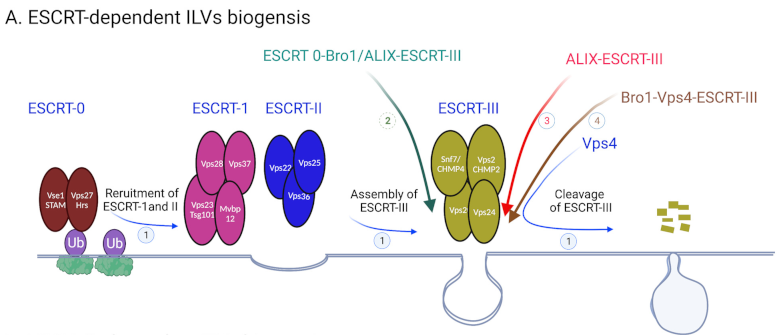
Figure 1. ESCRT-dependent ILVs biogenesis. VPS involved in the last step where it recognize CHMP
Constructing the script#
This time, we will analyze the NMR solution structure instead of crystal structure. There are two things to note when we analyze NMR solution structure. First, as the routine procedure in structure determination is through hydrogen spectra measurement, this method could identify the coordinate of hydrogen atoms. Second, as the structure captured in dynamic environment, it may contain more than one model/conformer. Therefore we will add the instruction to specify the conformation range that we would like to include in our analysis.
Before we start constructing the script, we should get the PDB structure of VPS4-CHMP6 complex which available at RCSB PDB with ID 2k3w.
According to the information at RCSB page, chain A refers to VPS4, while chain B refers to CHMP6.
Another important information is the number of model or conformer contained in PDB file which can be seen at Experimental Data & Validation section.
As the number of conformer is 20, we will instruct Deemian to read the conformation range from 1 to 20 like so:
vps4-chmp6-2k3w.txt
molecule 2k3w.pdb [
    select vps4 = protein and chain A
    select chmp6 = protein and chain B
]

measure vps4_chmp6 [
    interactions all
    ionizable positive true
    ionizable negative true
    between vps4 and chmp6
    conformation 1 to 20
]

present vps4_chmp6 [
    interactions vps4_chmp6.txt
    deemiandata vps4_chmp6.dd
]
Running and analyzing the results#
After we run the above script we will get the following results:
Deemian version: 0.0.0.post71+bad1636

interaction for "vps4:chmp6":
conf          1
    ELECTROSTATIC as_cation:

                         vps4        chmp6

    id                   315         1348
    atom_name            NZ          OE1
    res_name             LYS         GLU
    res_num.chain        23.A        176.B
    distance                         3.693


conf          3
    ELECTROSTATIC as_cation:

                         vps4        chmp6

    id                   315         1349
    atom_name            NZ          OE2
    res_name             LYS         GLU
    res_num.chain        23.A        176.B
    distance                         2.992

    id                   920         1292
    atom_name            NZ          OE1
    res_name             LYS         GLU
    res_num.chain        59.A        172.B
    distance                         2.950


conf          5
    ELECTROSTATIC as_cation:

                         vps4        chmp6

    id                   315         1348    1349
    atom_name            NZ          OE1     OE2
    res_name             LYS         GLU     GLU
    res_num.chain        23.A        176.B   176.B
    distance                         3.457   4.200
The vps4_chmp6.dd visualized with Deemian Viewer.
In the readable output above we can see that only conformer which contain interaction is displayed. Here, only conformer 1 to 5 is displayed as the whole output is too lengthy to display. The readable output results are reflected in Deemian data visualization with Deemian Viewer where some conformers display electrostatic interactions and some do not have them.
This tutorial demonstrate how easy it is to analyze the dynamic interaction between two proteins using Deemian and Deemian Viewer.